From Italy to the Middle East: Barbara Pizzi on Crafting Spaces with Purpose and Poetry
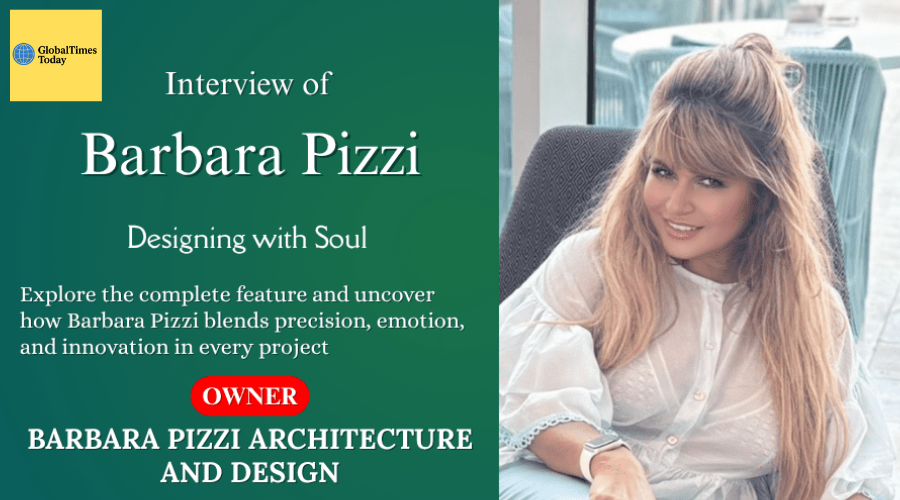
Architecture is often described as the art of shaping space – but for Barbara Pizzi, it is something deeper, almost spiritual. With a career spanning Italy, the Middle East, and beyond, she has built a practice rooted in precision, empathy, and cultural intelligence. Her studio, Barbara Pizzi Architecture and Design, blends Italian craftsmanship with Middle Eastern warmth, creating spaces that feel both contemporary and deeply human. In this exclusive interview, Barbara shares the philosophy, sustainability principles, and global experiences that shape her design language, revealing how architecture can heal, inspire, and connect.
Amira: Barbara, you’ve built a remarkable career as an architect working across Italy and the Middle East. Can you share how your journey in architecture began and what inspired you to establish Barbara Pizzi Architecture and Design?
Barbara Pizzi:
I was a traveller before I was an architect. Moving across Mediterranean cities and the Middle East taught me that places can heal when design respects their soul. I founded Barbara Pizzi Architecture and Design to build that kind of beauty: rigorous, contemporary, and human. From a Renaissance villa near Milan to our base in Dubai Design District, I shaped a studio able to work like an orchestra – architecture, interiors, brand storytelling, engineering, and logistics under one baton – so ideas can move from vision to reality with the same elegance they had on paper.
Amira: Your portfolio covers residential, commercial, and exhibition booth design. How do you approach each project type differently, and what are the key design principles that guide your work?
Barbara Pizzi:
Each brief begins with three questions: What is the place whispering? What must the human body feel? What should remain timeless? Homes demand intimacy and light choreography; commercial spaces require clarity and flow; exhibition design needs immediacy and theatre. Our principles are constant: proportion and calm, natural light first, material honesty, circular thinking, precision in detail, and technology that serves – never dominates – the experience.
Amira: Sustainability is becoming a central theme in modern architecture. How does your firm incorporate eco-friendly materials and sustainable design solutions into projects without compromising on aesthetics?
Barbara Pizzi:
For us, sustainability is not a constraint; it’s our aesthetic. We start with passive design – orientation, shading, thermal mass, and cross-ventilation – then add smart systems: high-performance envelopes, recycled and low-VOC materials, FSC timbers, lime plasters, recycled aluminium, grey water reuse, photovoltaic integration, and landscape that actually produces life (edible gardens and vertical greens). We run early LCA-style checks and design for disassembly so components can be reused. The result is quieter energy bills and spaces that age beautifully.
Amira: Your firm has strong expertise in the international trade fair sector. What makes designing exhibition booths unique compared to other architectural projects, and how do you ensure each booth captures the brand’s identity?
Barbara Pizzi:
An exhibition booth must convey a brand’s DNA in five seconds and perform flawlessly for five days. We treat booths as temporary architecture: a narrative spine, a single iconic gesture, multisensory cues, and a modular kit that ships well and reassembles fast. Our metric is simple: impact per kilogram. We aim for 70–80% reusability of structures, tool-less assembly where possible, and lighting that stages the product like theatre while meeting strict energy targets. That’s how identity becomes experienced.
Amira: You mentioned having studios both in Italy and the Middle East. How do cultural influences from these regions shape your design philosophy and project execution?
Barbara Pizzi:
Italy gave me discipline in proportion, craftsmanship, and material culture. The Middle East taught me generosity of space, hospitality as design, and the poetry of desert light and geometric patterns. Our projects merge both: Italian precision and craft with Middle Eastern warmth, courtyards, water, shade, and social rituals. Operationally, our teams in Lombardy and Dubai work as one studio – bilingual workflows, on-site artisans, and consultants who understand local codes and etiquette.
Amira: Can you share one or two of your most memorable projects—perhaps a luxury home or a trade fair installation—and what made them stand out creatively or technically?
Barbara Pizzi:
A private company in India: we created a micro-oasis with courtyards, water features and deep overhangs; daytime temperatures dropped significantly, noise levels were reduced and the company began to “breathe”. The client said, “It feels like our company is protecting us.”
Setting up a technology brand: a spectacular arched canopy, a 100% reusable substructure and a plug-and-play light grid. We reduced construction time by 30% and waste by more than half, while increasing visitor dwell time. Measurable beauty.
Amira: Collaboration seems key in architecture. How do you and your team of architects and interior designers ensure creativity and precision while managing global projects?
Barbara Pizzi:
The studio is an orchestra. We align early with a one-page brief, decision logs, and a “3 gates” process (concept clarity → technical truth → on-site choreography). BIM and shared models reduce surprises; rapid prototypes and mock-ups speed learning; daily stand-ups across time zones keep momentum. Everyone is responsible for the poetry and the math—designers, engineers, QS, and contractors at one table from day one.
Amira: Many of your projects emphasise elegance, functionality, and emotional connection. How do you balance artistic creativity with the practical needs of clients?
Barbara Pizzi:
We design in three layers: Body (function and comfort), Mind (clarity and order), and and Soul (emotion). Light, acoustics, material temperature, scent, and touchpoints are composed like music. We co-create scenarios with clients – how they arrive, work, rest, and host – and then we edit, edit, and edit until only the essential remains. That is our definition of elegance.
Amira: For young architects and designers, especially women entering the field, what advice would you give about building a global brand and succeeding in the architectural industry?
Barbara Pizzi:
Build a compass, not a map. Learn the craft deeply, but also the language of business – contracts, IP, budgets, and storytelling. Choose mentors who challenge you. Be global and local at once. Protect your vision with kindness and courage; they are not opposites. And remember: the ability to sell a good idea with integrity is a design skill.
Amira: Looking ahead, what’s your vision for Barbara Pizzi Architecture and Design in the next few years? Are there any upcoming projects or innovations you’re particularly excited about?
Barbara Pizzi:
We’re scaling a replicable habitat model that unites architecture, productive landscapes, and wellness – between desert and sea – so places become self-sustaining and culturally alive. We’ll keep pushing circular materials, AI-assisted design paired with high craftsmanship, and partnerships with research and art institutions. I’m excited about “The Garden of Knowledge”, a biophilic cultural axis that turns learning into a spatial experience. The goal is simple and ambitious: architecture that generates life – economically, socially, and spiritually – in a planetary approach.
Conclusion
Barbara Pizzi’s work stands as a reminder that architecture is more than form or function – it is an experience, a narrative, and often a transformation. Her ability to merge sustainability with beauty, precision with poetry, and global perspectives with local authenticity places her among the most thoughtful designers of her generation. As she continues to shape new cultural, residential, and commercial environments, her vision remains clear: to create architecture that enriches life emotionally, socially, and sustainably. The journey ahead promises innovation, purpose, and spaces that leave a lasting imprint on the people who inhabit them.